
1. Why close week feels endless
Month-end close is rarely slow because accountants cannot add numbers. It is slow because people spend days:
- Copying data between systems
- Chasing “why doesn’t this invoice match the PO?”
- Waiting on approvals buried in email
- Reconciling reports that disagree because each team has its own spreadsheet version of truth
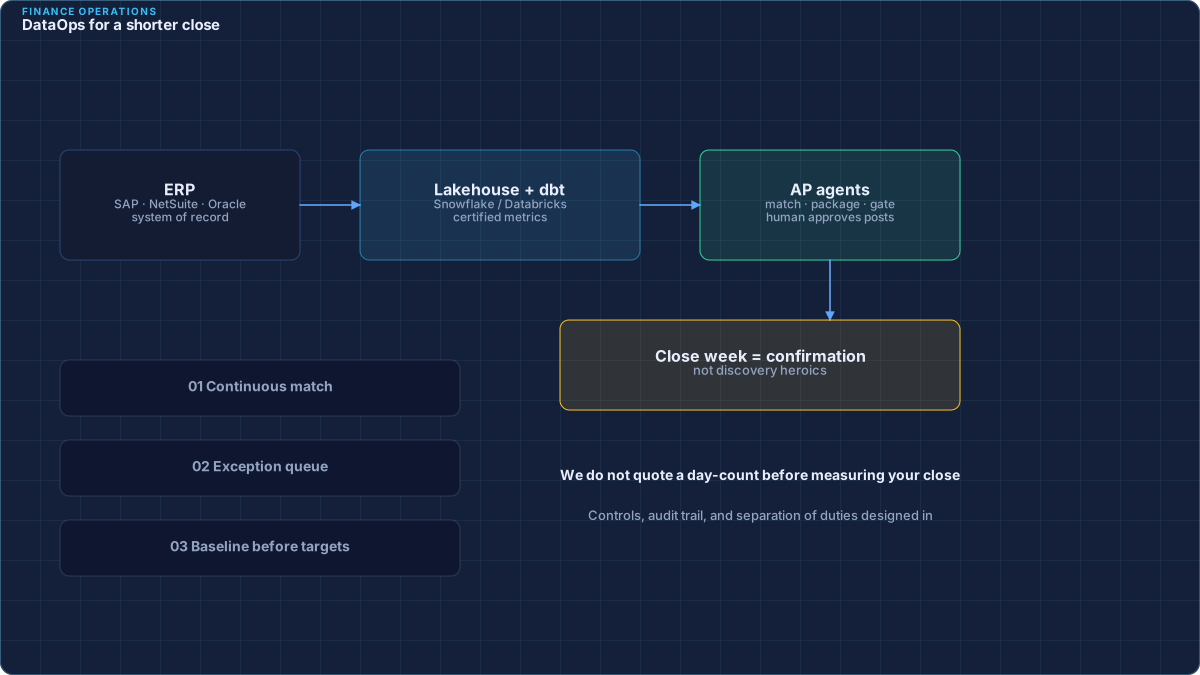
Close cycles vary enormously by organization, ERP hygiene, and how many entities have to be consolidated — from a few days to several weeks is common in the industry. The goal of modern finance operations is continuous readiness, so that the final days are confirmation rather than discovery. We do not publish a benchmark figure here because we do not have one we can stand behind; we measure your baseline before setting a target.
2. What “DataOps agents” do for finance
DataOps is the practice of treating data pipelines with the same rigor as software: tested, monitored, and owned. Agents sit on top of those pipelines to act on issues automatically.
For finance, that looks like:
- Watching new AP invoices as they arrive
- Matching them to purchase orders and receipts
- Classifying routine matches vs. true exceptions
- Preparing a clear package for a human when judgment is required
- Writing outcomes back to the ERP so reporting stays consistent
They do not replace the controller. They remove the scavenger hunt.
3. Connecting ERP to the lakehouse
Your ERP (SAP, NetSuite, Oracle, and similar) remains the system of record for postings. A lakehouse (Snowflake or Databricks) becomes the place where data from many systems is combined for analysis and intelligent automation.
A healthy pattern:
- Ingest ERP changes frequently (near real time when possible).
- Model certified metrics with dbt — cash, AP aging, exception counts — so everyone shares definitions.
- Act with agents that read those models and only write back through controlled, audited interfaces.
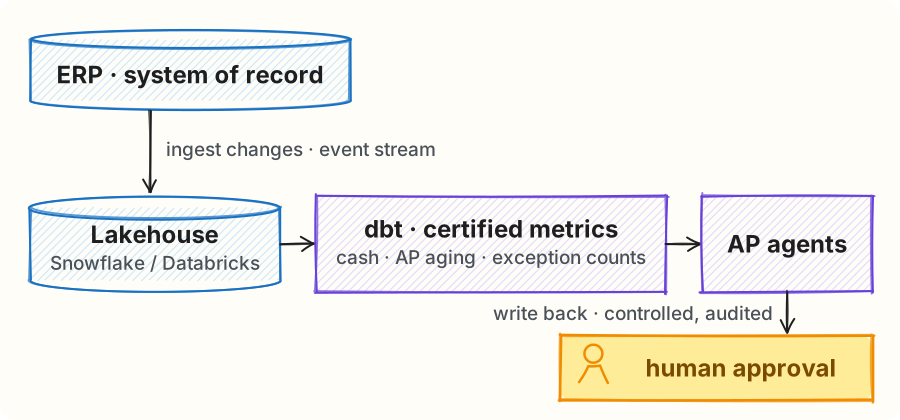
Kafka-style event streams (or cloud equivalents) help the agent react in seconds instead of waiting for a nightly dump.
4. A day in the life (before vs after)
| Moment | Before | After agents + lakehouse |
|---|---|---|
| Invoice arrives | Sits in inbox / queue until someone opens it | Extracted and matched within minutes |
| Mismatch found | Email thread with screenshots | Structured exception with suggested fix + one-click path |
| Mid-month | Surprises wait until close | Controllers see open issues daily |
| Close week | Heroics and late nights | Mostly confirmation of already-reviewed items |
5. Controls, audit, and trust
Finance automation only sticks if audit and control owners trust it. The controls we put in with your team include:
- Separation of duties — agents propose; policy decides who can approve.
- Immutable logs — who saw what, what the agent recommended, who approved.
- Thresholds — dollar limits, confidence scores, vendor risk tiers.
- Replay — ability to re-run a decision path for auditors without guessing.
This is why checkpoints and structured tools matter as much as the AI model.
6. What to measure
We will not tell you what you are going to save before we have seen your data. What we will do is agree on metrics up front, take a baseline, and report against it:
- Calendar days from period end to sign-off
- Manual touches per invoice, and how many are avoidable
- Exceptions opened, resolved, and still open at cut-off
- How much of the close depends on one or two individuals
If those numbers do not move, the program is not working, and a report that says so is more useful than one that does not.
Pair this with industry context: banks and insurers care about controls; manufacturers care about three-way match and inventory; professional services care about project cost recognition. The pattern is the same; the policy knobs differ.
7. Getting started without chaos
Do not “AI the whole close” in one project. A safer sequence:
- Stabilize core finance data into Snowflake or Databricks with agreed metric definitions.
- Pick one exception type with high volume and clear rules (e.g., price variance under a threshold).
- Run the agent in recommend-only mode for a full period.
- Enable limited auto-actions with human approval for the rest.
- Expand to neighboring exception types once the first is trusted.
Cloudadorn can support this with data modernization engineers, AI agent specialists, and embedded FDE pods who work inside your finance systems — not from a slide deck.